 |
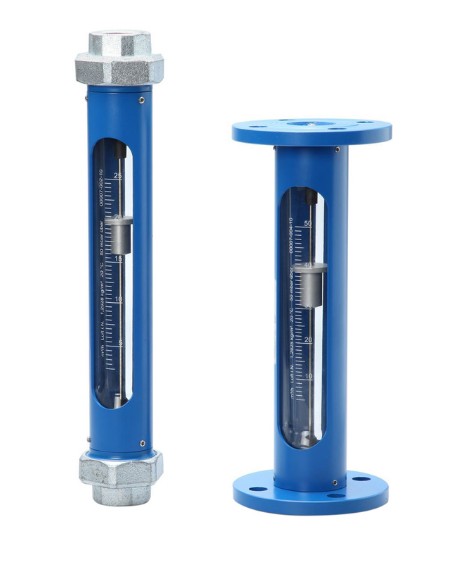
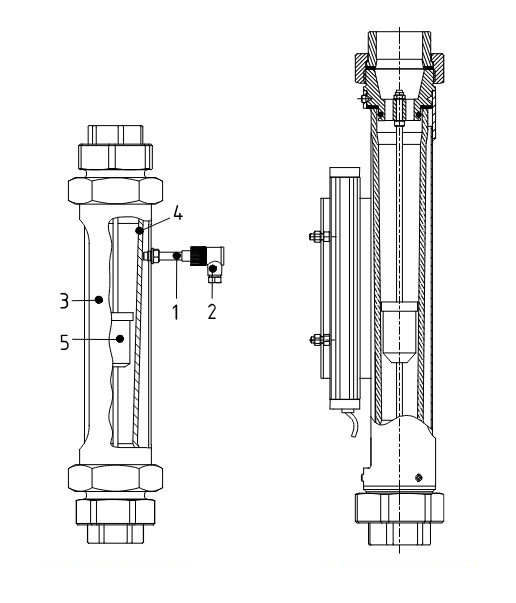 Left : Output contacts Right : 4-20 mA output with Hall-effect sensor 1) MSK limit switch 2) M12 angular connector 3) Variable area flow meters (or rotameters) 4) Measuring tube 5) Magnetic float (specific term for the float used in a variable area flow meter) |
 PRINCIPLE |
Direct measurement and visualisation of instantaneous flow rate of gases and liquids:
Water treatment, industrial processes (paper, textiles, etc.), chemical and pharmaceutical industries, heating or cooling circuits
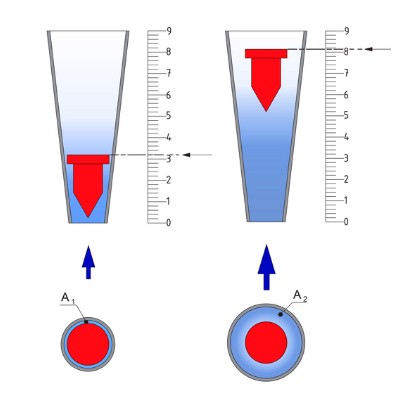
The measuring principle is that of a variable area flowmeter, achieved by a float moving inside a calibrated conical glass tube. The borosilicate glass cone is housed in a protective steel tube with a viewing window.
Available versions:
| RA 65 | threaded connection Rp ¼" to Rp 3" | |
| FA 65 | flanged connection DN 10 to DN 65 | |
| RA / FA 65-MSK1 | with limit switch (normally closed contact) | |
| RA / FA 65-MSK2 | with limit switch (normally open contact) | |
| RA / FA 65-MSKW | with changeover contact | |
| RA / FA 65-EM | with 4 ... 20 mA analog output | |
| RA / FA 65... Ex | explosion-proof version |
Limit switches:
These flowmeters can be equipped with a magnetic float and electrical reed contacts, adjustable across the full measuring range.
4–20 mA analog output:
The output is obtained via a Hall-effect linear displacement sensor. A 4–20 mA signal is generated, representing the position of the float. The sensor is connected via the supplied M12 × 1 connector. The assembly is compact and offers a high level of repeatability. An LED indicator mounted on the strip displays the measuring range.